
Operational Infrastructure
As service businesses grow, the way work is managed becomes more complex. More clients. More processes. More tools.
New platforms are introduced to solve immediate problems. A CRM is added. Automation tools are implemented. Internal dashboards appear. Client portals are introduced.
Individually, each system may improve part of the workflow. But over time these tools often become disconnected. Teams spend time switching between platforms, managing manual tasks, and repeating processes that should be automated.
Operational infrastructure focuses on designing systems that allow the business to operate efficiently as it grows.
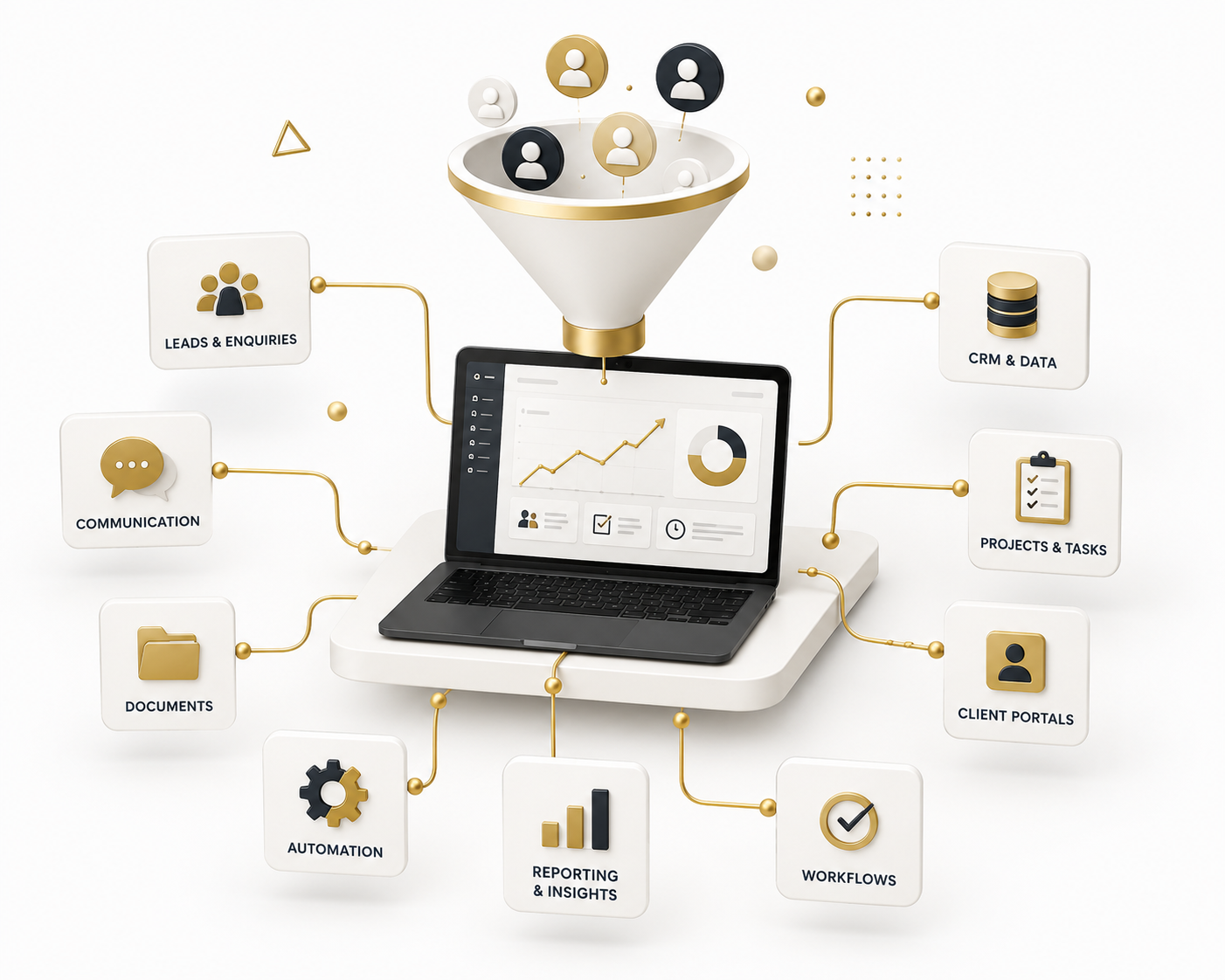

Why Internal Systems Often Become Fragmented
Operational systems rarely appear all at once. They develop gradually as the business evolves. A CRM might be introduced to manage leads. Automation tools may be added later to streamline marketing.
Project management platforms are implemented as teams grow. Without a coordinated system behind them, these tools begin to overlap.
Information becomes fragmented. Processes slow down. Instead of supporting growth, the systems begin to create friction. Operational infrastructure solves this by designing the underlying systems that connect everything together.
What Operational Infrastructure Includes
Operational infrastructure focuses on improving how work flows through the business.
Rather than simply adding new tools, the goal is to design systems that simplify operations and remove unnecessary complexity.
Internal Applications
Some businesses benefit from purpose-built internal applications.
These systems are designed around the specific workflows of the business rather than forcing the business to adapt to generic software.
Internal apps may be used for:
- Managing internal workflows.
- Handling complex client processes.
- Centralising operational data.
These systems are often built as web applications that integrate with existing tools.
Automation Systems
Automation can remove many repetitive tasks that consume valuable time.
Operational infrastructure may include automation systems that handle processes such as:
- Lead routing.
- Client onboarding.
- Reporting workflows.
- Task generation.
- Notifications and updates.
Automation allows teams to focus on higher-value work rather than manual administration.
Client Portals
Client portals can significantly improve the experience of working with a business.
Instead of relying on scattered emails and documents, clients gain a structured environment where they can:
- View project updates.
- Access resources.
- Submit requests.
- Track progress.
This reduces communication friction and improves transparency.
System Integrations
Many businesses rely on multiple platforms to operate.
CRMs, project management systems, finance tools and communication platforms all store important information.
Operational infrastructure focuses on integrating these systems so that information flows smoothly between them.
This reduces manual data entry and ensures teams have access to accurate information.
When Businesses Need Operational Infrastructure
Businesses often reach a point where internal systems begin to slow progress.
When these issues appear, improving operational infrastructure can significantly increase efficiency.
Common signs include:
- Repetitive manual tasks.
- Disconnected software tools.
- Complex client onboarding processes.
- Difficulty accessing reliable operational data.
- Increasing administrative workload.
How Operational Infrastructure Fits the Breeze Model
Operational infrastructure forms the third pillar of the Breeze Digital Infrastructure Model.
Conversion Infrastructure
Ensures your website converts visitors into enquiries.
Demand Infrastructure
Ensures potential clients can find your business.
Operational Infrastructure.
Ensures your internal systems support growth efficiently.
Together these systems create a strong foundation for sustainable growth.
What Happens When the Infrastructure Is Right
When the right systems are in place, a website becomes far more than an online brochure. It becomes a reliable lead generation system.
Visitors understand your services more clearly. Conversion pathways are easier to follow. Enquiries become more consistent.
This creates a stronger foundation for marketing and future growth.
Operational Infrastructure FAQs
Operational infrastructure refers to the internal systems that allow a business to operate efficiently. This includes automation, integrations, internal applications and client portals.
Not always. In many cases existing tools can be integrated effectively. Custom applications are useful when workflows are complex or existing software does not meet the needs of the business.
Yes. Operational infrastructure is often designed to connect existing tools together so that information flows between them more effectively.
Automation can be highly effective for service businesses, particularly for processes such as onboarding, reporting and internal task management.
Some systems evolve over time as businesses grow. Ongoing optimisation ensures the infrastructure continues to support new processes and workflows.
Discover Where Your Systems May Be Slowing Growth
If internal tools, workflows or manual processes are beginning to slow your team down, the first step is understanding where improvements can be made.
Through our Digital Infrastructure Audit, we identify opportunities to simplify operations and improve efficiency.
Book a Strategy Call to get started.
